



















































De functieleer in het merkenrecht en de holistische benadering van het HvJ EU
14-11-2012 Print this page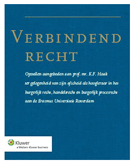 B9 11836. Prof. mr. Tobias Cohen Jehoram, Erasmus Universiteit, De Brauw Blackstone Westbroek: The function theory in trade mark law and the holistic approach of the ECJ. (Eerder gepubliceerd in Verbindend Recht, liber amicorum K.F. Haak, Kluwer 2012, pp. 177-188).
“For this article I turn to a theory developed by the (European) Court of Justice ("CoJ") in the field of trade mark law: the function theory. In the past years it has become the pivot of trade mark protection within the EU, which is remarkable as no word on the function can be found either in the Trade Marks Directive or the Community Trade Mark Regulation. (…) Below I will try to first provide a theory on the genesis of the function theory; let me already now give away that I think it comes from an adjacent area of the law. This will be followed by a synthesis of where we stand today. I will also aim to indicate what his might mean for future developments. Finally, I will have a brief look as to where else the ECJ is applying non-trade mark doctrine in trade mark law.
(…) As we have been able to conclude from the above, the CoJ is struggling with the legal structure of trade mark law and seems to overstep the legal possibilities when confronted with interfaces with other areas of the law. The CoJ then seems to have (especially) little concern for the trade mark law legislation. The judges in the court seem more familiar with fields like competition law, which then tends to influence the approach of the CoJ (as we have seen), also earlier, in cases like Magill . (….) Nevertheless, one should realize that the CoJ is in a difficult position, trying to reconcile different legal systems with each other, while few of them were actually drafted with a view to other legal structures. The holistic approach –the reader will pardon me for using this euphemism- of the ECJ does not lead to well structured application of the law, but a hotchpotch of casuistic rulings which should lead the way in specific circumstances. It does not help to bring legal certainty or clarity, which makes it even more important for academics to keep showing the way.
So what Krijn has always taught us, once again is proven true: different fields of law influence each other, and in more ways than one. And there is no end to academic strive, which is also why I expect and hope to hear and read more from Krijn after his retirement.
Lees het gehele artikel hier. Bestel het boek hier.