






































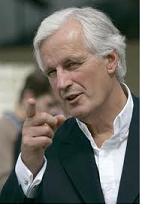
 Speech Michel Barnier, (European Commission, Internal Market): Bringing online music within the reach of all Europeans. (Cannes, 27 January 2013, MIDEM 2013 Conference "Music for everyone’).
In any event, we must find solutions that protect and improve the operation of the internal market, stressing the fight against infringements on a commercial scale in accordance with the principle of "follow the money".
“(…) the availability of some of the most popular online music providers is still very uneven between Member States. How can it be, for example, that some of them are not available in Italy or Poland? And that only three out of the 20 most popular operators may be accessible from certain Member States? But music lovers are not the only ones encountering difficulties.
•I am thinking in particular of all those investing – often heavily – in identifying, producing and distributing new talents, and whose work is too often immediately accessible on illegal download sites.
•I am thinking also of all those entrepreneurs wishing to offer innovative streaming-based services, social media or cloud services, who come up against the compartmentalisation of national markets.
This is despite the fact that the potential of the online music sector is immense, with 30 % of worldwide record label sales already taking place online and revenues increasing by 8 % in 2011 alone.Whether consumers, investors or entrepreneurs, it is incomprehensible that Europeans are finding on the Internet obstacles they have been removing in the physical world for over 50 years.
We all know that these problems have multiple causes, some of which have nothing to do with copyright, such as insufficient broadband network capacity in Europe, the commercial strategies of service providers, the cost of payment services and so on.
Copyright must no longer form part of these obstacles. It should not be a lock, but a modern and effective tool for supporting creation and innovation, providing access to high-quality content across borders, encouraging investment and strengthening cultural diversity.To achieve this objective, acting on an initiative from me the European Commission has adopted two complementary approaches.
I – Firstly, whenever possible, we must encourage dialogue with the industry and the principal stakeholders, who hold the keys to resolving many of the current difficulties. Acting on my proposal, the Commission decided at the beginning of December to launch the "Licences for Europe" initiative.(…).
II – On the other hand, where necessary to ensure dynamism in Europe, we must be prepared to legislate. This is the default path; the one we must give preference to where negotiation does not permit the removal of the obstacles blocking access to music in Europe. (…)
In any event, we must find solutions that protect and improve the operation of the internal market, stressing the fight against infringements on a commercial scale in accordance with the principle of "follow the money".
Finally, I wish to look at what I call the "relegitimisation" of copyright in the digital age. We cannot give free rein to the illusion that everything is free. Nor can we give the impression that, in an age when file duplication is instant and infinite, unlimited sharing of protected content is covered by a kind of "digital natural law", particularly when profit is the objective.But in order to be heard in these matters, we must also be better able to demonstrate the crucial importance of an effective and efficient intellectual property system for the vitality of our societies.
Lees de gehele speech hier.
B912070