



















































EU Report: The economics of copyright and AI, Empirical evidence and optimal policy
23-03-2026 Print this page
This in-depth analysis, commissioned by the European Parliament’s Policy Department for Justice, Civil Liberties and Institutional Affairs at the request of the Committee on Legal Affairs, examines how copyright policy should respond to artificial intelligence (AI). It combines historical lessons from digital markets, insight on the economic value of data, and a formal model to study welfare effects. It assesses economic effects of various policy options, including an exception, an exception with opt-out, licencing market (“opt-out”) and statutory licencing, in a search for optimal policy.
Key Findings
Consumers ultimately fund incentives. Copyright royalties are largely borne by end users, not AI firms. This makes consumer welfare—not just creators’ or firms’ interests—the central benchmark for policy.
Statutory licensing appears optimal. Among realistic options, statutory licensing emerges as a robustly welfare-superior framework under most calibrations. Making the licence compulsory ensures wide access to works, a royalty rate set by a regulatory authority balances interests of rightsholders, AI developers and end users, enabling royalty payments that create incentives for enough new creation to keep AI systems valuable over time.
Other regimes underperform. Relying on licensing markets alone risks suffering from high clearance costs and too little available training data due to opt-outs. Copyright exceptions without remuneration risk undercutting incentives for future creation. Copyright exceptions without remuneration and opt-outs appear as the worst policy option, because opt outs reduce access to the existing stock of data and there is no funding for a continued flow of data.
Complementary measures matter. Statutory licensing is most effective when paired with lean administration, strong competition enforcement in the AI market. To encourage further research and development, I propose a targeted carve-out for non-commercial research that links eventual commercialisation back to creator funding.
Geopolitical relevance. With most AI development outside Europe, statutory licensing in Europe helps ensure that a sustained flow of European works remains in training datasets, making non-European AI services reflective of preferences of European consumers (e.g. corresponding to local languages) and therefore valuable for European consumers.
Policy Roadmap
1. Consider statutory licensing with royalties set by an independent authority that balances interests of rightsholders, AI firms, and—crucially—consumers/end users.
2. Prioritise lean, transparent administration—automated tools where possible, CMOs as secondbest.
3. Integrate copyright with competition and research policy, including the DMA and DSA.
4. Close evidence gaps through systematic disclosure on training data, retraining frequency, and royalty flows.
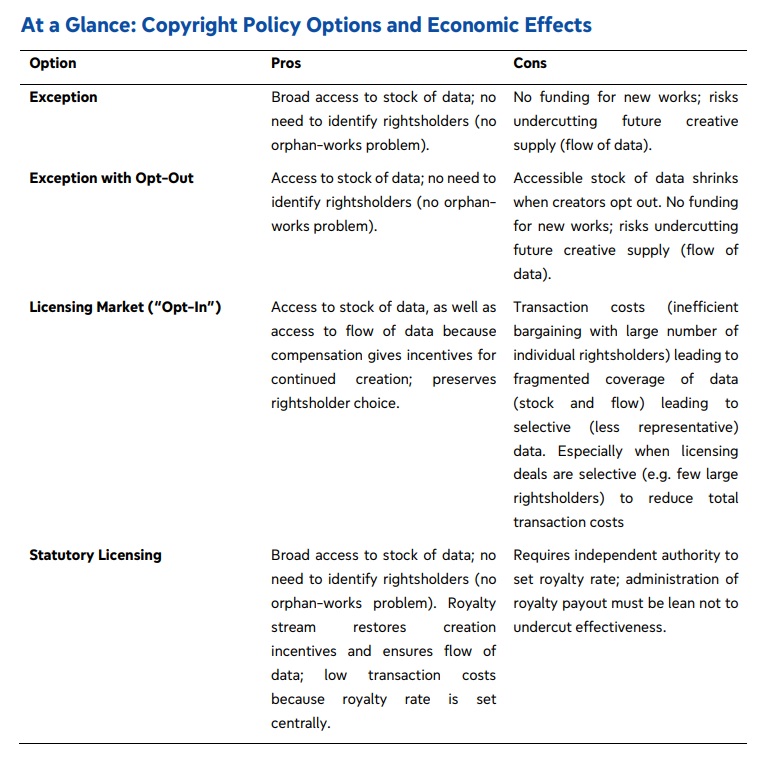
Statutory licensing, carefully designed and implemented, offers a pragmatic compromise: it secures broad access, sustains incentives and minimises costs. In doing so, it provides a viable path for Europe and beyond to balance cultural production with technological innovation in the age of AI.