














































 B9 11571. Hoge Raad Noorwegen, 27 Juni 2012, HR-2012-01325, Trumf AS tegen Stokke AS & Peter Opsvik AS. (Met dank aan Tobias Cohen Jehoram, De Brauw Blackstone Westbroek (advocaat Stokke)).
“The scope of protection will be determined by how original and distinctive an artistic work is. The scope of protection reflects the scope of the individual creative effort.”
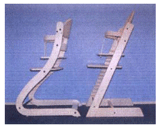
Auteursrecht. Noorse Tripp Trapp-zaak m.b.t. de inbreukmakende Oliver-kinderstoel. De Oliver heet in Nederland Carlo (afbeelding links) en is in Nederland inzet van een cassatieprocedure (Hof Amsterdam van 15 maart 2011 IEPT20110215). De Noorse Hoge Raad neemt auteursrecht aan, oordeelt dat er sprake is van een ruime beschermingsomvang en dat de Olivier inbreuk maakt op het Tripp Trapp auteursrecht. Klassiek onderwerp voor een IE-discussie: Hoe verhouden oorspronkelijkheid en beschermingsomvang zich tot elkaar, in het bijzonder bij werken van toegepaste kunst (zie b.v. dit arrest, met specifieke conclusie van AG Verkade). De Noorse Hoge Raad oordeelt:
(86) It will be noted that Professor Jacobs’ assessment is largely a function of his views with regard to the copyright issue. This has implications when it comes to what weight can be attached to his views. There would seem to be general agreement, at least in Denmark, Sweden and Norway, that the degree of innovation has consequences in terms of how broad the protection against imitations is in scope. The scope of protection will be determined by how original and distinctive an artistic work is. The scope of protection reflects the scope of the individual creative effort. Although it will generally be problematic to grant extensive protection to items intended for practical use that meet everyday needs, such a perspective carries limited weight in relation to a distinctive artistic work like the Tripp Trapp chair. The German ruling I referred to earlier emphasises, in particular, the wide freedom of choice facing Mr Opsvik in the detailed design of his highchair – also within the limits defined by the technical solution. The same is emphasised in the decision of the Office for Harmonization in the Internal Market of 12 February 2008, in which the design registration of a chair similar to the Oliver chair was declared invalid at the request of Stokke AS: “The examples of prior designs of highchairs given by the Holder demonstrate that despite these technical constraints there is still a large degree of freedom for designers of highchairs. In particular, there is no need for using a characteristic L-shaped structure which characterizes the prior design.”
(…) (93) After having inferred that the Oliver chair cannot be considered an independent artistic work, the Court of Appeal concludes as follows: “The artistic distinction of the Tripp Trapp chair lies, as previously mentioned, in innovative individual elements, and the original combination of these with older, known individual elements. The Court of Appeal is of the view that the said elements are replicated to a very large extent in the Oliver chair. Consequently, the predominant part of those characteristics of the design expression that convey the identity of the Tripp Trapp chair are also found in the Oliver chair. The similarities are very extensive, not least when considering the large scope for variation that presents itself. All in all, the Oliver chair must be perceived as a very close imitation of the Tripp Trapp chair.” (94) I agree with this summary, and it follows from this that the Oliver chair represents an infringement of the copyright protection conferred on the Tripp Trapp chair.
Lees het arrest hier.
Boek9.nl wordt gesponsord door:

Advertenties



Advertenties