



















































Gemeenschapsmodel markeerstift nietig wegens overeenstemming met ouder vormmerk
02-07-2013 Print this page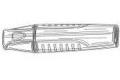
Gemeenschapsmodellen – Beroep ingesteld door de houder van gemeenschapsmodel, strekkende tot vernietiging van beslissing de derde kamer van beroep van het BHIM, waarbij voor de tweede keer is verworpen het beroep tegen de beslissing van de nietigheidsafdeling houdende toewijzing van de vordering tot nietigverklaring die was ingediend door de houder van de nationale en internationale beeld- en driedimensionale merken die een schrijfinstrument weergeven, voor waren van klasse 16, na de vernietiging van de aanvankelijke beslissing bij arrest van het Gerecht in zaak Beifa Group/BHIM - Schwan-Stabilo Schwanhäußer.
Beifa voert zeven middelen aan ter ondersteuning van haar beroep. Het beroep wordt afgewezen met betrekking tot alle zeven vorderingen. Er is geen sprake van onjuiste rechtsopvattingen van de kamer van beroep. Met betrekking tot de beeld- en driedimensionele merken van Beifa en Stabilo is er sprake van verwarringsgevaar, zodat het model van Beifa nietig is.
87 As the Court held, in particular, in paragraphs 72 and 77 of the Instrument for writing judgment, the applicant had the right to submit a request before the Invalidity Division that the intervener be required adduce proof of genuine use of the earlier mark at issue; however, the applicant referred to the issue of proof of genuine use of that mark for the first time in the pleadings setting out the grounds for its appeal before the Board of Appeal. Even assuming that those pleadings could be construed as containing a request for proof of genuine use of the earlier mark at issue, a request of that kind, made for the first time before the Board of Appeal, is inadmissible and cannot be taken into consideration and examined by the Board of Appeal. The Board of Appeal set out that finding in the contested decision (paragraph 24).
88 In the present case, the applicant claims, furthermore, that the request for proof of genuine use, submitted before the Board of Appeal, was not submitted under Article 43(2) and (3) of Council Regulation (EC) No 40/94 of 20 December 1993 on the Community trade mark (OJ 1994 L 11, p. 1), as amended (now Article 42(2) and (3) of Council Regulation (EC) No 207/2009 of 26 February 2009 on the Community trade mark (OJ 2009 L 78, p. 1) and that the case-law relating to that article should not apply. In the applicant’s opinion, its request ought to have been examined as a late filed argument under general principles.
89 That issue has also already been examined in the Instrument for writing judgment, in which it was held that, since no specific provision is made in Regulation No 6/2002 concerning the procedure for requesting proof of genuine use of the earlier sign, to be followed by the proprietor of the Community design in respect of which an application for a declaration of invalidity has been brought on the basis of the earlier sign, that request had to be submitted to OHIM expressly and in due time, that is to say, in principle, within the period of time granted by the Invalidity Division to the proprietor of the Community design for submitting its observations in response to that application (Instrument for writing judgment, paragraph 67). That finding must also be applied in the present case.
90 As the Court noted in paragraphs 69 and 71 of the Instrument for writing judgment, the case-law based on Article 42(2) and (3) of Regulation No 207/2009 applies also, by analogy, to requests for proof of genuine use made in the context of invalidity proceedings in accordance with Article 25(1)(e) of Regulation No 6/2002, because in this context, too, it is unacceptable that the Board of Appeal could be put in the position of having to rule on a dispute which is different from the dispute brought before the Invalidity Division, that is to say, a dispute the scope of which has been extended through the addition of the preliminary issue of genuine use of the earlier sign relied on in support of the application for a declaration of invalidity.
91 Consequently, the fifth plea in law must be rejected without it being necessary to rule on the plea of inadmissibility raised by OHIM at the hearing.
Lees het arrest hier.