
















































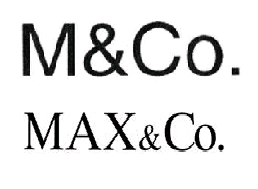
 Gemeenschapsmerk – Beroep door houder van de nationale en gemeenschaps-beeldmerken met het woordelement „MAX&Co.” voor waren en diensten van de klassen 18, 24, 25, 35 en 42 ingesteld en strekkende tot vernietiging van beslissing R 1199/2012 2 van de tweede kamer van beroep van het BHIM houdende verwerping van het beroep tegen de afwijzing door de oppositieafdeling van de oppositie die verzoekster had ingesteld tegen de inschrijving van het beeldmerk met het woordelement „M&Co.” voor waren en diensten van de klassen 25 en 35.
Het beroep wordt verworpen. Er is geen sprake van verwarringsgevaar tussen het aangevraagde beeldmerk met het woordelement “M&Co” en de oudere nationale en gemeenschaps-beeldmerken met “MAX&Co.” De betrokken tekens zijn visueel en fonetisch verschillend en conceptueel is er een zeker gebrek aan gelijkenis. Het argument dat door het hoge onderscheidende vermogen van het oudere merk, alle elementen, inclusief "&co" onderscheidend vermogen hadden verkregen wordt afgewezen. Het verkrijgen van onderscheidend vermogen door gebruik en de vraag of een merk of de elementen van dat merk intrinsiek onderscheidend vermogen hebben zijn twee verschillende onderwerpen.
53 With respect to the conceptual comparison of the signs, the Board of Appeal found, in paragraph 39 of the contested decision, that a certain similarity stems from the presence of the element ‘&co.’ in the signs in question. As regards the elements which differ in each of the signs, the element ‘max’ of the earlier signs would be understood as a masculine first name whereas the letter ‘m’ present in the sign applied for is a letter of the alphabet. However, in view of the weak distinctive character of the common element ‘&co.’, the Board of Appeal found that the signs in question display a certain dissimilarity. Those findings must be upheld.
61 [...] The question whether a mark has acquired an enhanced distinctive character through use and the question whether that mark or the elements of which it is composed are inherently distinctive are two different issues. The fact that a mark can be recognised as having acquired an enhanced distinctive character through use does not however mean that it or the elements of which it is composed must be recognised as having an inherently high degree of distinctiveness. To that effect, OHIM correctly observes that, where a mark has a highly distinctive character, that distinctive character must be ascribed to that mark as a whole and not to all the elements of which it is composed, in particular to those elements which are inherently weak, as is the case with the element ‘&co.’ in the present case. Consequently, the applicant is mistaken in submitting that, on account of the purported highly distinctive character of the earlier mark, the element ‘&co.’ automatically has a highly distinctive character.
Lees het arrest hier.
IEPT20141203, GEU, Max Mara Fashion Group v BHIM